
Are you looking for ways to get rid of large amounts of food waste? There are numerous options available, but the best option can typically be found by focusing on capacity. Not every option for sustainable disposal of food waste is designed to handle the large amounts of food waste produced by commercial organizations. This is the case when it comes to solar digesters.
At a glance, solar food digesters have much in common with biodigesters. But organizations managing significant amounts of waste will want to evaluate these options with care. Below, we explain the difference between solar digesters and biodigesters to help you decide which option might be best for your sustainable food waste disposal needs.
How It Works: Solar Digester vs. Biodigester
Both solar digesters and biodigesters provide sealed alternatives to composting. Unlike composting, these systems reduce the risk of having odors attract animals. Both options also speed the decomposition process compared to composting. Neither solar digesters nor biodigesters result in a compost-like soil additive. Instead, the rapid, oxygen-rich decomposition processes that solar digesters and biodigesters enable creates a grey water that can be used in landscaping.
Below, we break down the differences between each of these food waste disposal options.
What is a Solar Digester?
Solar digesters are in-ground systems that rely on heat from the sun to rapidly break down food waste. Plastic cones and metal cans typically form the aboveground portion of these systems as these materials help trap heat. Some ready-to-purchase systems feature air chambers that help circulate the airflow necessary for an aerobic, or oxygen-rich, decomposition process. This is essential as it is the lack of oxygen in landfill decomposition that causes food waste to release dangerous levels of methane gas.

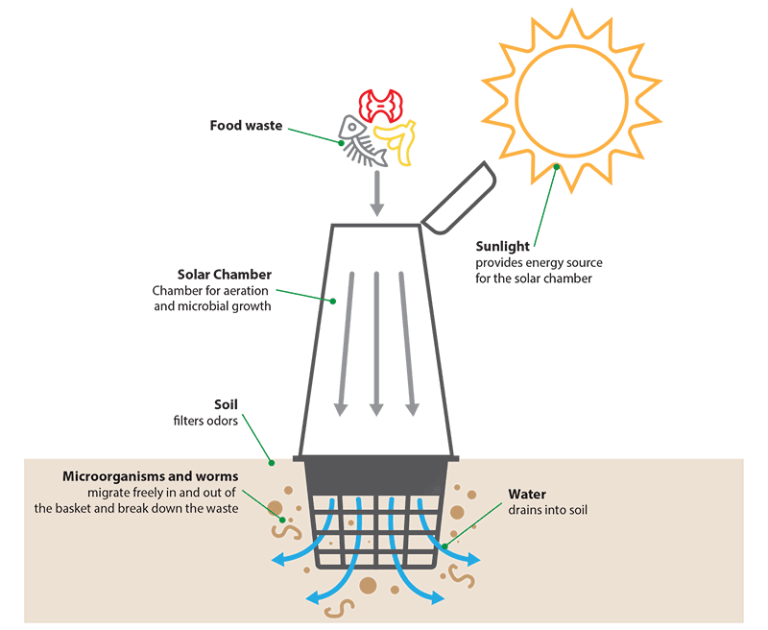
Below ground, these systems feature baskets with holes. The holes allow worms and other decomposers to enter and leachate to exit the system. Solar digesters should be located in areas that are well drained to facilitate this movement. While options are available for purchase, DIY solar digesters can be made using galvanized metal cans, so long as holes have been drilled into the below-ground portion of the container.
Unlike with biodigesters or composting, solar digesters do not usually require waste be stirred. Even without stirring, solar digesters typically finish breaking down waste within six to 12 months, according to Seattle Public Utilities. Commercially available units reportedly can break down up to 1 kg (2 lb) of food waste daily. More sophisticated units can also accept a wider range of waste types including, in some cases, pet waste.
The most significant limitation of today’s solar digesters is that they are limited to residential use. A standard solar digester is able to effectively manage food waste for up to five people each day. For larger amounts of waste, more units must be installed. This limitation makes most solar digesters an impractical choice for large producers of food waste but ideal for families with available outdoor space.
What is a Biodigester?
A biodigester is a piece of equipment designed to accelerate the process of breaking down food waste. An LFC biodigester uses a motor that periodically turns the contents of an internal drum, slowly mixing food waste with microorganisms. This turning process introduces oxygen and is timed to help the microbes fully digest food waste.

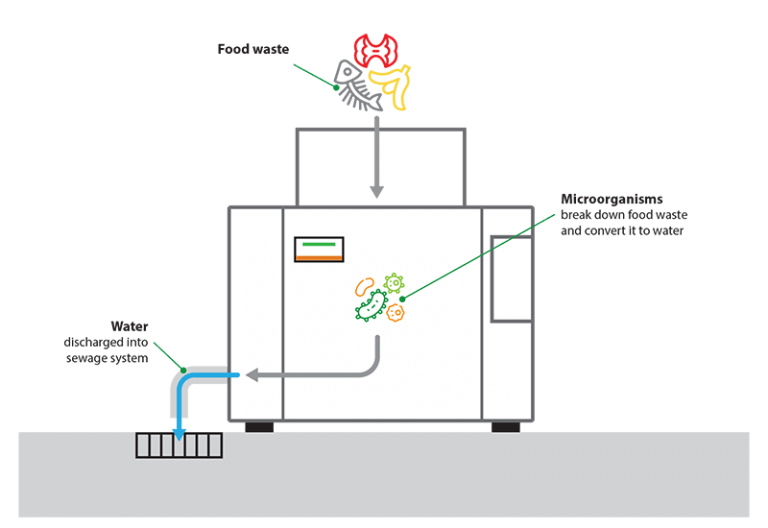
Because the LFC biodigester is fully sealed, it can be installed directly in commercial kitchens for easy access without the risk of odors that attract pests. This also reduces the time spent transporting waste from the kitchen. Units must be connected to a power source, a drain and water.
Operation is as simple as opening the lid of the unit and adding in food scraps. Waste can be added at any time of day.
Like solar digesters, an LFC biodigester emits grey water. However, it also provides a unique byproduct: data. LFC biodigesters weigh the amount of waste managed and can be programmed to track the types of waste introduced. Through connection to the cloud, LFC biodigesters can easily support reporting such as:
- The amount of waste food digested hourly, daily, weekly, monthly, and yearly.
- The types of waste being digested.
- The amount of CO2 diverted from the landfill each hour, day, week, month and year.
Which is Right for You: Solar Digester vs. Biodigester
If you’re looking for an environmentally responsible option for food waste disposal, but composting isn’t right for you, then solar digesters and biodigesters both hit the mark. To determine which option might be right for you, consider asking the following questions:
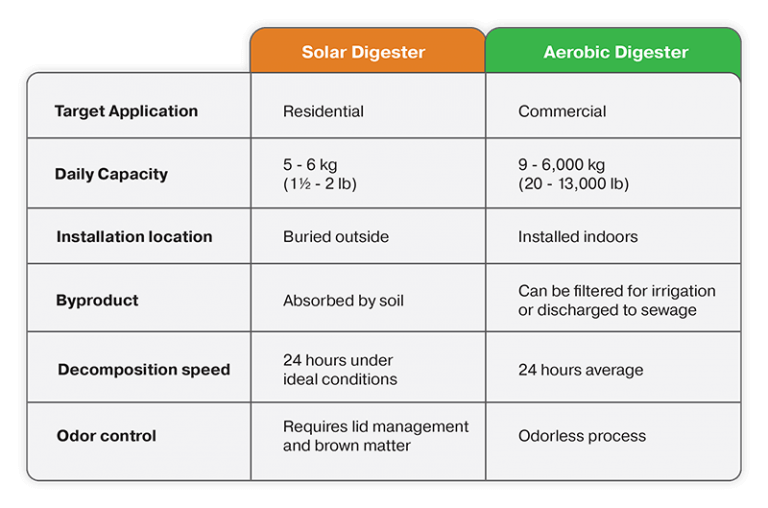
| Solar Digester | LFC biodigester | |
| How much waste do I need to dispose of each day? | Solar digesters are designed to manage up to 1 kg (2 lb) of food waste per day – approximately the amount of waste generated by five people. | LFC biodigesters are available with options that break down anywhere from 9 to 6,000 kg 20 to 13,000 lb) of food waste each day. |
| Do I want to go outside to dispose of food waste? | Solar digesters are installed directly into the earth and rely on the sun’s heat to work. | LFC biodigesters are designed to be installed in the kitchen to simplify the disposal of food waste. All byproducts are disposed of down the drain. |
| Can I use the byproducts of the unit’s decomposition process? | Yes; solar digesters break waste down into grey water that can be used in landscaping. | Yes; LFC biodigesters break waste down into grey water that can be used in landscaping. |
| How quickly does decomposition happen? | Under certain conditions, solar digesters can break down food waste in as little as 24 hours. | LFC biodigesters break down most food waste within 24 hours. |
| Do I need to provide additives to help food waste break down? | Additives are available to help speed the decomposition process in solar digesters. | The Powerzyme mixture of microorganisms and enzymes is necessary to accelerate the digestion of food waste. |
| Will the unit emit smells or attract pests? | Tight-fitting lids can help reduce the risk of unwanted pests. Adding brown matter, such as grass, can help reduce the risk of smells. | Because units are sealed, LFC biodigesters do not emit smells that attract pests. |

Move Your Organization to the Right Sustainable Food Waste Disposal Option
Most food-producing organizations will recognize that there is an LFC biodigester option available to match the level of waste they generate. Specially designed units are also available to meet certain industries’ unique needs, including the marine, prison, and agricultural industries. With all of these options available, organizations of every size can feel confident that there’s an LFC biodigester available for them. If you’re ready to simplify the disposal of food waste and reduce your carbon footprint, explore your LFC biodigester options or contact Power Knot today.